
The JintellarCore platform
AI infrastructure for financial operations.
Connect fragmented data, legacy systems, spreadsheets, and broker reports. Then automate the manual work between them.
One system, one set of rules, and endless knowledge that compounds.
Existing estate
Systems, data, APIs, scripts
JintellarCore
Reason, connect, execute and prove
Enterprise asset
Owned, reusable and measurable
The problem
Financial firms do not have one data environment.
Portfolio managers work in Excel and OneDrive. Broker research arrives through email and PDFs. Market data lives in Bloomberg or LSEG. Internal records sit in databases, OMS platforms, and legacy applications. Hedge funds and asset managers do not have an AI problem. They have an operational fragmentation problem.
Bloomberg and LSEG market data
Broker reports in email and PDFs
Excel models and OneDrive files
Internal databases and warehouses
OMS, EMS, and fund accounting
Legacy applications
Personal Python, VBA, and PowerShell scripts
Manual review and approvals
JintellarCore sits above this environment, orchestrating the data, automating the workflows between the systems, and never requiring the firm to replace them first.
Shadow automation
Your teams already built the connective tissue on their laptops.
Analysts and engineers bridge the gaps every day with personal scripts, spreadsheets, and their own AI tools. The work gets done. The firm keeps almost none of it.
Ungoverned
Personal scripts and AI tools run outside review, policy, and audit. They remain invisible to the firm that depends on them.
Unshared
The workflow works, but it lives on one laptop or in one personal account. The next desk rebuilds it from scratch.
Unretained
When the owner changes teams or leaves, the workflow, its logic, and its history leave with them.
Worked example · Daily position and cash reconciliation
One workflow, before and after.
Move the same process a fund operations team runs every morning onto the runtime without replacing a single upstream system.
Before JintellarCore
- Data arrives from brokers, custodians, internal databases, and spreadsheets.
- Operations staff manually compare records across systems.
- Exceptions are investigated through emails and separate applications.
- Evidence is collected by hand for review.
With JintellarCore
- 01Data is ingested from each approved source.
- 02Matching and exception rules run automatically.
- 03AI investigates unmatched records using permitted context.
- 04Material exceptions are routed to a reviewer.
- 05Decisions, evidence, outputs, and cost stay attached to the workflow.
Measured on every run
Time per run
Records processed
Exceptions raised
Human review time
AI and infrastructure cost
Completion rate
Four ways in
You do not have to standardize on one interface.
JintellarCore is a platform boundary, not a single screen. Operators, builders, engineers, and external applications enter through the surface that fits their work and land in the same governed runtime.
Import what already works
Existing scriptsBring in Python, Bash, PowerShell, Node, and other existing automation logic. Keep the useful code while adding AI, ownership, evidence, and lifecycle.
Design the workflow
Visual automationCombine AI steps, tools, branching, human review, durable outputs, and governed context in Automation Studio.
Code directly in JintellarCore
First-party workspaceUse the built-in Coding Workspace for project context, agent-guided changes, terminal work, Git state, artifacts, and publishing.
Connect the tools teams use
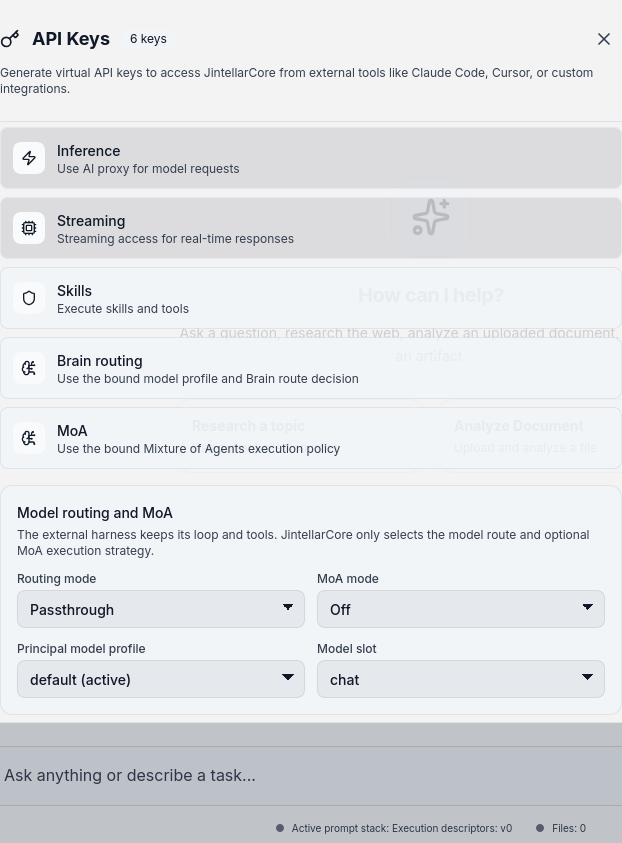
AI gatewayGive coding agents and compatible applications a governed route to approved models and skills through scoped virtual API keys.
Inside JintellarCore
The path, and the product that runs it.
JintellarCore coordinates the systems, AI, code, and people underneath a process, while teams see the work, decisions, evidence, and outputs.
Business workflow
One operating path across systems, AI and human judgment
High-level business view
- 01
Connect
Systems, databases, APIs and scripts
- 02
Compose
AI, code, tools and routing logic
- 03
Review
Human decisions and exceptions
- 04
Execute
Actions across configured systems
- 05
Retain
Outputs, evidence and reusable versions
The compounding loop: completed work preserves decisions, outputs, evidence, and exceptions for the next version.
Integration Center
Connect systems of record and enterprise tools

Virtual-key gateway
Govern external applications
Automation Studio
Compose AI, tools, flow, people, and outputs
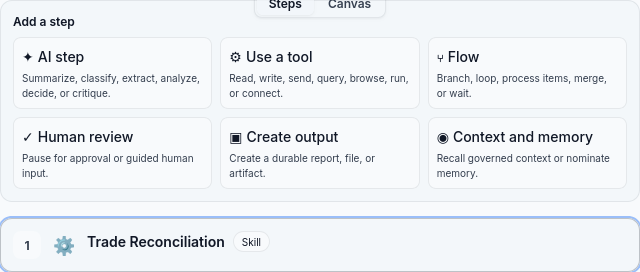
Product captures from a running JintellarCore deployment. No credentials, customer data, or tenant identifiers are shown.
A different system boundary
More than workflow automation alone.
This is not a claim that other tools cannot do their jobs. It is a description of what JintellarCore is designed to combine in one governed runtime.
| Tool category | What it primarily does | What JintellarCore adds |
|---|---|---|
| Zapier / n8n | Connect applications and automate tasks | Finance workflow context, human review, lifecycle, audit, and enterprise retention |
| AI coding tools | Generate and modify code | Governed model access, organizational context, and captured execution history |
| Internal scripts | Solve local problems | Ownership, discoverability, versions, monitoring, and continuity |
| Legacy workflow systems | Run established processes | AI, coding, document intelligence, and cross-system orchestration |
AI gateway for external applications
Keep the tool. Govern the route.
External tools keep their own experience, agent loop, and local tools. JintellarCore supplies the authorized model route and can expose approved skills without distributing upstream provider credentials.
Tenant and principal-bound access
Scoped inference, streaming, skills, and routing
Expirable and revocable virtual credentials
Model routing, usage, and audit at the gateway
The thesis
Human capital becomes token capital.
Employees contribute judgment, operating knowledge, and workflow design. AI contributes token-funded execution. JintellarCore preserves both as a reusable enterprise asset: the decisions people made and the work the tokens paid for. When an analyst resolves an exception, the decision, the evidence, and the approved workflow change stay with the firm, so the next case is handled consistently.
| What is retained | Kind | Why it matters |
|---|---|---|
| Enterprise Automation Registry | Inventory and custody | A firm-owned inventory of reusable automations with owners, versions, lifecycle state, discovery, and run bindings. |
| Human contribution history | Judgment | Reviews, exceptions, corrections, and approved decisions remain attached to the work. |
| Run and evidence lineage | Proof | Each execution connects to its jobs, outputs, artifacts, errors, approvals, and audit evidence. |
| Workflow economics | Cost and output | Measure AI and tool consumption at workflow level alongside completed output and operating history. |
Start with one painful process
Bring us the work everyone knows is too manual.
The platform is running today, and we are selecting our first design partners for finance workflows. Tell us the process. We will map the systems, handoffs, reviewers, exceptions, outputs, and evidence a credible first deployment needs.